Longleat Safari Park in Wiltshire are taking part in a ground-breaking project, along with a number of other zoo’s in Europe, to save the world’s rarest rhino from extinction.
The northern white rhino had an estimated wild population of thousands as recently as 1960, but was virtually wiped out in the 2000s due to poaching.
Today only three individuals are left; an elderly male and two females who are kept under strict armed security at the Ol Pejeta Conservancy in Kenya.
The male, Sudan, is now 43 years old and reaching the end of his life, while both females have medical problems which prevent them from conceiving naturally.
In a final attempt to try and save the sub-species a team of European scientists and conservationists have been working on advanced reproductive techniques.
Initial tests at an Italian laboratory specialising in assisted reproduction of large animals have produced encouraging results using eggs from southern white rhinos fertilised by both southern and northern white rhino sperm.
Although closely related, southern and northern white rhinos are actually two distinct sub-species which are thought to have begun diverging around a million years ago.
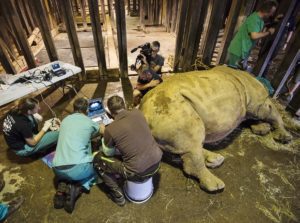
Longleat is the first UK-based zoological collection to take part in the programme and experts have now visited the UK in an attempt to replicate the procedure at the Wiltshire safari park.
The team have initially harvested a total of nine eggs from Longleat’s three female southern white rhinos which have been transported back to the laboratory in Italy to hopefully be fertilized with male white rhino sperm.
If successful the plan is for the resulting IVF embryos to be re-implanted back into a selected group of females later this year.
“Effectively the females rhinos would act as IVF mothers; with embryos partly derived from northern white male sperm,” said Longleat’s Head of Animal Operations Darren Beasley.
“If the procedure works the hope would be that southern white females would carry the developing embryos for up to 18 months before giving birth.
“This IVF and embryo transfer programme truly is the last best hope to save them from extinction,” he added.
If the treatment proves successful it is hoped it could be used, alongside conservation programmes, to help boost numbers of other highly endangered species.
For information on visiting Longleat go to www.longleat.co.uk