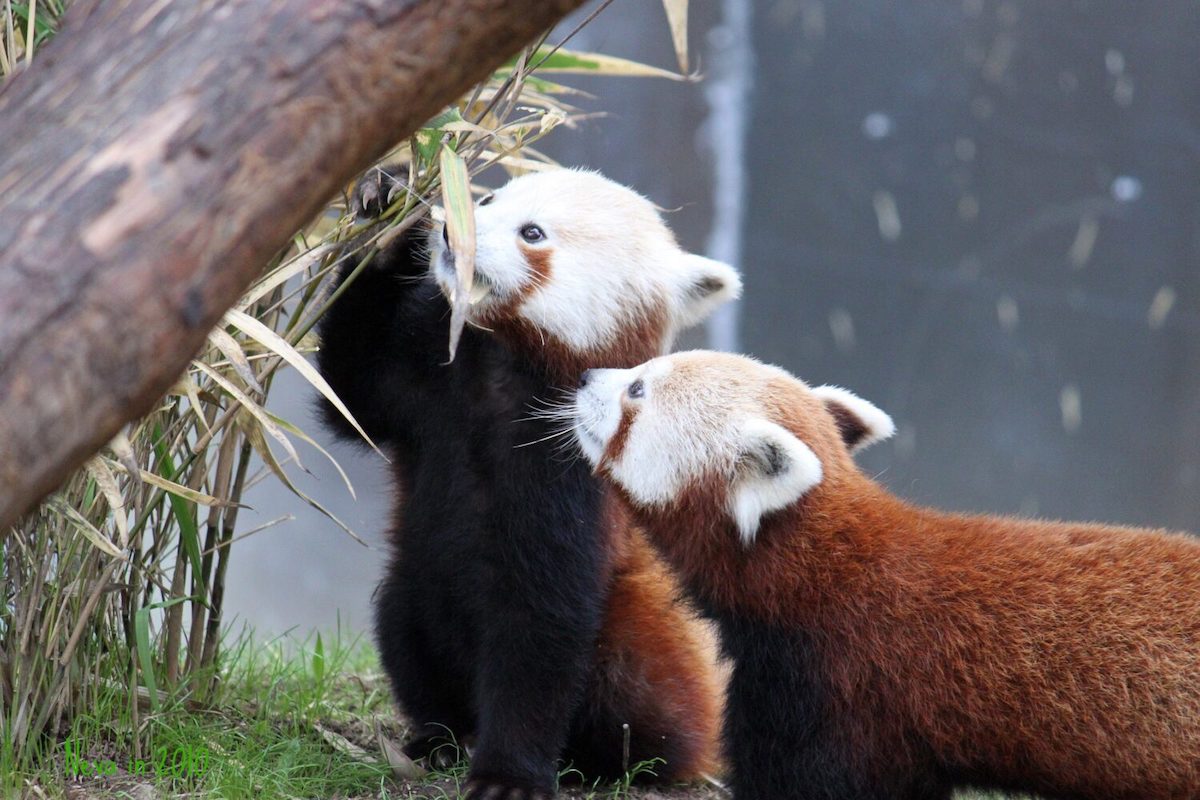
Kitty, the Highland Wildlife Park’s female red panda, gave birth to twins on 15th June.
These twins are the second successful red panda birth at the park as Kitty reared a single cub in 2013, a male called Kush, who was recently sent to Curraghs Wildlife Park on the Isle of Man as their new breeding male. Kush was the first red panda to be born in one of the Royal Zoological Society of Scotland’s animal collections in 13 years.
Douglas Richardson, Head of Living Collections for the Highland Wildlife Park, comments: “We are of course thrilled by the birth of twin red pandas, but it is doubly satisfying as a number of red panda pairs in zoos breed once, then do nothing in subsequent years. The fact that Kitty has produced cubs two years in a row is a very strong indication that our enclosure, diet and husbandry regime suits this pair of pandas.”
It will be a few weeks before Kitty, her mate Kevyn and the unnamed cubs, whose sexes are also still unknown, will be on display, as this is a delicate time for both mum and infants. Red panda cubs are born blind, only opening their eyes after about 18 days.
Red pandas are native to the Himalayas in Nepal, Bhutan, India, Laos, Myanmar and southern China. The name ‘panda’ comes from the Nepalese word ‘nigalya panya’, literally ‘bamboo eater’. Despite what their name suggests, red pandas are not related to giant pandas (which are part of the bear family), but are distantly related to the raccoon family. They have no close living relatives, with their nearest ancestors living 3-4 million years ago. Red pandas are threatened, with the major threat being destruction by man of the forested mountainous areas (between 1800m – 5000m) where they live. Although they are protected in all the countries where they are found, they are still hunted illegally for their fur and in particular their long bushy tail which is highly prized as a good luck charm for Chinese newlyweds.
Red pandas are classified as Vulnerable on the IUCN Red List with less than 10,000 individuals thought to remain in the wild. The population is threatened by both deforestation and poaching. The Highland Wildlife Park is part of the European Endangered Species programme (EEP) that is run by the European Association of Zoos and Aquaria (EAZA).