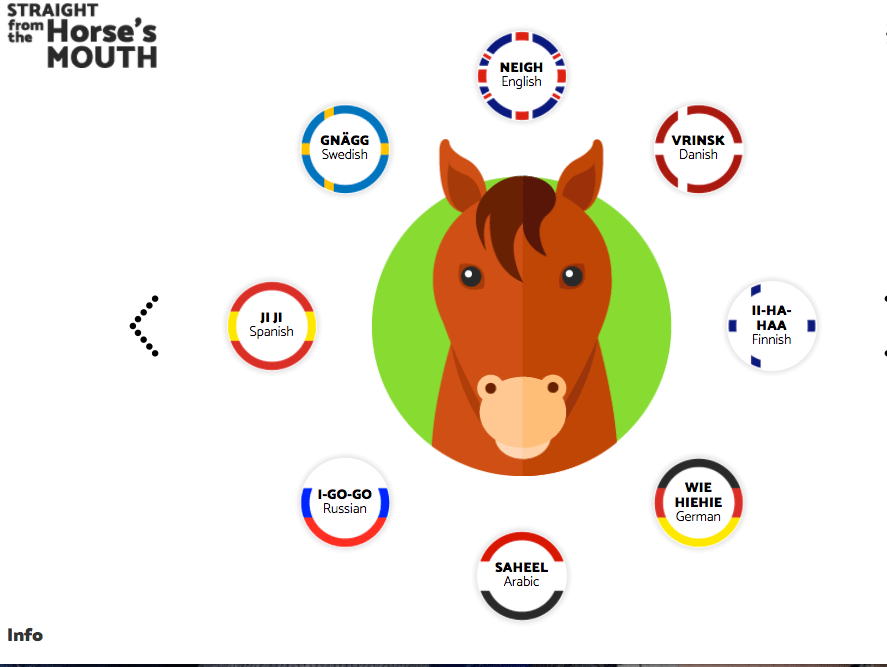
Research company Verve Search has identified a number of studies into international animal onomatopoeia and one leading professor in his field, Derek Abbot of the University of Adelaide, claims that this topic actually suffers from ‘academic neglect’. You can read about his study on this topic here.
In the above, he says that there is still a lot to understand about why animal sounds are different around the world. With this in mind, the agency decided to ask people from a range of countries around the world to say out loud how they interpret a number of different animal sounds. The findings were then out into an educational, interactive piece at http://www.gocompare.com/pet-insurance/from-the-horses-mouth
A duck quacks in English, but apparently says ‘ga ga’ in Japanese.
- A horse says JI ji in Spanish and Saheel in Arabic
- A mouse says Piep Piep in German, Squit Squit in Italian and PI-PI-PI in Russian
- Dogs say Hav Hav in Turkish and Meong Meong in Korean
- A bear says Kahkaa in Arabic and in Romanian it’s Mor
- A pig says Grunz Grunz in German and Kvik Kvik in Czech
- The humble bumble bee says Zoum-Zoum in Greek and Wing Wing in Korean