A pioneering conservation project reached an historic milestone yesterday as European bison were released into an ancient woodland in Kent to help tackle the climate crisis, as the UK bakes in record-breaking temperatures.
This is the first time bison have roamed in the UK for thousands of years. The historic event occurs two years into a five-year project by the charities Kent Wildlife Trust and Wildwood Trust, funded by players of People’s Postcode Lottery.
In the cooler part of the day, shortly before 7am, the bison were released into West Blean and Thornden Woods. They are are ‘eco-system engineers’ which means they will restore life to the woodland through their natural behaviours and offer a nature-based solution to tackle the climate and biodiversity crisis. These natural behaviours such as grazing, eating bark, felling trees and taking dust baths will open the canopy, creating light and new spaces for wildlife and previously missing species to thrive. By creating layers within the forest and naturally felling trees, the woodland will move away from being a monoculture, and wetter areas will not only store carbon, but reduce flood risk.
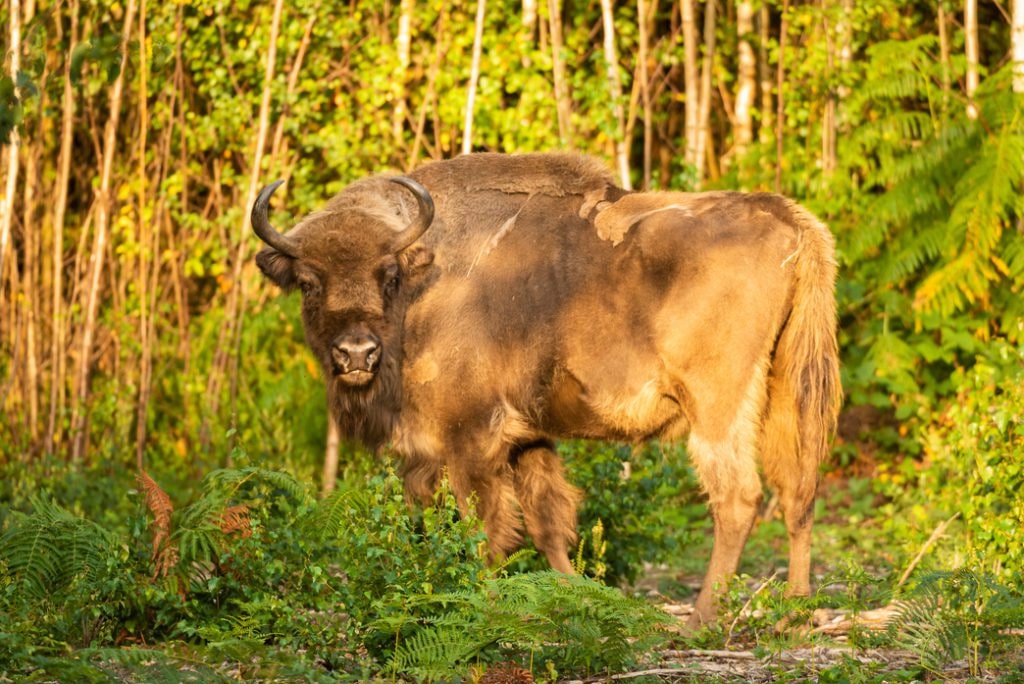
Evan Bowen-Jones, Chief Executive Officer at Kent Wildlife Trust, said: “The restoration of naturally functioning ecosystems is a vital and inexpensive tool in tackling the climate crisis.
“The bison will help to create climate resistant landscapes which can adapt to the challenges presented by the crisis we face.
“We want Wilder Blean to mark the beginning of a new era for conservation in the UK. We need to revolutionise the way we restore natural landscapes, relying less on human intervention and more on natural engineers like bison, boar and beaver.
“Equally important, is that the Wilder Blean project will connect people with nature in a way that hasn’t been possible before in the UK because we haven’t had big wild animals present in our landscapes. We hope that those who visit the woodland and learn about the project will be inspired by what we are doing and become champions for nature too.”

The bison will soon be joined by other grazing animals, including Exmoor ponies, Iron Age pigs and Longhorn cattle, whose natural behaviours compliment the bison and will help to manage the landscape without the need for human intervention. Their impact on biodiversity and the landscape will be closely monitored in a long-term survey programme led by Kent Wildlife Trust.
Paul Whitfield, Director General of Wildwood Trust, said: “Today heralds a new dawn for conservation and the fight against climate change.
“As well as helping the biodiversity crisis, one of the fantastic things about this ground-breaking project is that it’s going to demonstrate the very real impact nature-based solutions can have in solving the climate crisis. The two are intrinsically linked and we can’t solve one without the other.
“With this project, we’re going to prove the impact bison in the wild can have on the environment. They will create an explosion of biodiversity and build habitat resilience; locking in carbon to help reduce global temperature rise. This will act as a huge catalyst for change, with the project being replicated on scale across the country. It will make a phenomenal difference. It’s great news in these worrying times.
“Not only this but we’re giving people in the UK – for the first time in over a thousand years – the chance to experience bison in the wild. It’s a really powerful emotional, visceral experience and it’s something we’ve lost in this country. It’s an absolute privilege to be part of the team that’s bringing that back.”

The Wilder Blean project was created as a direct response to the decline in natural species in the UK, which, according to the State of Nature Report, has seen species decline at the fastest rate in thousands of years. Introducing bison is also an alternative to traditional human woodland management, giving nature the tools and space it needs to recover.
The impact of the animals on the landscape will be part of an ecological monitoring programme led by Kent Wildlife Trust. This includes monitoring multiple ecological parameters to detect changes over time. Everything from soil sampling and worm counts to collecting data on vegetation structure will be examined. The team will also be monitoring several different groups of species including, invertebrates, birds and mammals. Read more about the Wilder Blean monitoring programme here.
More about bison:
European bison (Wisent) were almost extinct in the wild at the end of the Second World War. Since then they have recovered but still remain an endangered species. Several pioneering projects in Europe, including in the Netherlands, have seen these animals return from the brink and demonstrated the incredible impacts they can have on species diversity and abundance. The Blean bison will form part of the European Endangered Species Protection Programme and this project will be a pioneering first for UK Conservation.
Main image credit: Robert Canis
European Bison: The Nature Monograph