The largest programme in history to discover life in our ocean was unveiled earlier this year – Ocean Census – with the ambitious target of finding at least 100,000 new marine species in the first decade.
Knowledge gathered will revolutionise our understanding of life on Earth and how to protect the ocean – the environment responsible for much of the air we breathe, regulating our climate, and a vital food source for billions.
Scientists believe little more than 10% of what lives in our seas has been found and there are around two million species still undiscovered. The endeavour builds on major programmes of the past including The Challenger Expeditions (1872-1876, the birth of modern marine science) and The Census of Marine Life (2000-2010).
Ocean Census is a global collaborative initiative, an open network of science, business, media and civil society organisations joining forces. It has been founded by The Nippon Foundation, the largest non-profit foundation in Japan that focuses on philanthropy through social innovation, and Nekton, a UK-based marine science and conservation institute. The project’s headquarters is in Oxford.
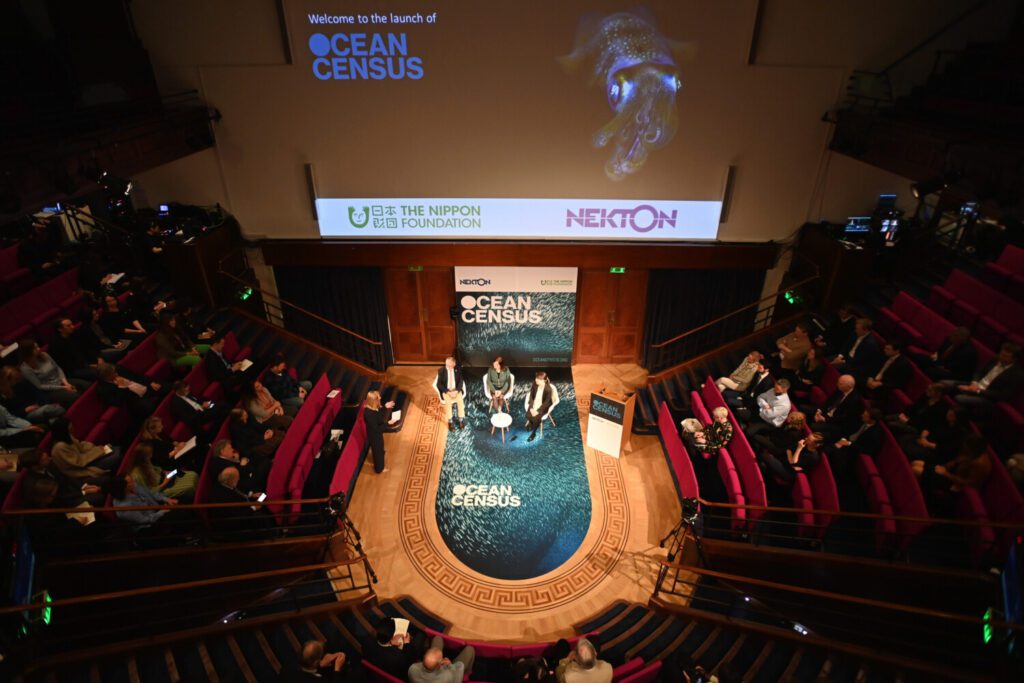
“Ocean life makes all life on Earth possible and holds the wisdom of four billion years of our evolution on Earth. We can’t protect what we don’t know exists”, explained Yohei Sasakawa, Chairman of The Nippon Foundation. “We have a race against time to discover ocean life before it is lost for generations to come. Ocean Census will create an immense wealth of openly accessible knowledge that will benefit and sustain all life on Earth, for humankind and our planet. Ocean Census is full of dreams and wonder, and cannot be accomplished by the Nippon Foundation and Nekton alone. We would like to unravel the mysteries of the ocean, in collaboration with ocean research institutes, businesses, governments, the public, philanthropy and civil society.”
For the past 200 years, the work of finding and scientifically describing species (taxonomy) has been a slow, methodical process – the average rate of new species discovery hasn’t changed much since the 1800s. It stands at around 2,000 a year. Traditional taxonomy is unable to meet the challenges of the climate and biodiversity crises that scientists expect will result in the loss of the majority of species on Earth.
“Revolutions in technologies such as digital imaging, sequencing and machine learning, now make it possible to discover ocean life at speed and at scale”, said Professor Alex Rogers, Ocean Census Science Director, “It currently takes one to two years to several decades to describe a new species after it is collected by scientists but utilising new technologies and sharing the knowledge gained using cloud-based approaches, it will now only take a few months.”.
Over the coming years, scientists from around the world will embark on dozens of expeditions to the ocean’s biodiversity hotspots to find new life from the surface to full ocean depth. Combining vessels from the philanthropic, government and commercial fleets, they will be deploying a combination of advanced subsea technologies with divers, submarines and deep-sea robots.

Species discovered on expeditions will be sent for high resolution imaging and DNA sequencing in a network of Ocean Census Biodiversity Centres to be established in high, middle and low-income nations around the world. Networks of taxonomists will connect virtually to draw on what Professor Rogers and his scientific team calls ‘Digital Life Forms’ to complete species descriptions.
The aggregated, open-sourced data will be added to a network of data centres globally and made freely accessible to scientists, decision makers and the public.
“This new foundation of knowledge can help advance our understanding of fundamental science – oxygen production, carbon cycling, sustainable food production, the evolution of life on Earth and even discoveries of new medicine and biotechnologies,” revealed Mitsuyuki Unno, Executive Director of The Nippon Foundation. “Through advancing our understanding of the abundance, diversity and distribution of life in our ocean, we hope Ocean Census will catalyse global efforts to conserve our ocean.”
“We have a short window of opportunity, perhaps the next ten years, when the decisions we all make will likely affect the next thousand or even ten thousand years”, explained Oliver Steeds, Ocean Census Director, Chief Executive of Nekton. “Some people are saying ‘it’s time to go big or go home’. We’ve chosen to go big, and we hope the giant leaps in knowledge we can make with the discovery of ocean life can help put us on a better track towards a positive future for people and the planet.”

Ocean Census is particularly timely. The 2022 Montreal Biodiversity Conference made the decision to protect 30% of our planet for conservation of life by 2030. Implementation of this ambitious policy in the ocean will need the information provided by Ocean Census to ensure that protected areas are optimally positioned to protect biodiversity.
The UN Biodiversity Beyond National Jurisdiction treaty agreed in March 2023 means that there is now a legal framework to establish such protected areas in the high seas. Lack of progress on prevention of global warming detailed in the IPCC 2023 Climate Report emphasises the urgency of action to understand the ocean and its potential responses to climate change as well as its potential to mitigate emissions and adapt through nature-based solutions.
For more information visit oceancensus.org
World Ocean Census: A Global Survey of Marine Life